What To Do for a Middle School Science Fair: Project Ideas and Tips

Science fairs give middle school students a chance to see how science fits within daily life by asking questions and testing ideas. It’s common to feel stuck at first, especially when choosing a topic or figuring out how to turn an idea into a full project.
If you’re not sure What to Do for Science Fair in Middle School, start with a simple question you can test. A good project doesn’t have to be complicated. It just needs to be clear, organized, and allow you to explore your curiosity.
In the following guide, I discuss project ideas and planning tips to help you build confidence and apply STEM skills.
Why Science Fairs Matter in Middle School
Science fairs teach more than just science facts. Not only do they help you practice problem-solving, communication, organization, and critical thinking, but you’ll also learn how to ask questions, make a hypothesis, collect data, analyze your results, and explain your findings.
Middle school is a great time to build these habits because you’re becoming a more independent learner. Through your science fair project, you will see that science isn’t just something you read about in textbooks, but also a way to explore the world around you.
For more hands-on STEM ideas, students and families can explore STEM Activities for Middle School Students That Build Real-World Skills.
How To Choose a Science Fair Topic
Finding the best science fair topic starts with something you already find interesting. Rather than picking a topic that just “sounds cool,” ask yourself:
● What am I curious about?
● Can I test this idea safely?
● Can I measure the results?
● Do I have enough time and materials?
● Can I explain what I learned clearly?
A good project needs a question you can test. For example, “Do plants grow better with music?” This question is interesting, but the results aren’t measurable. You can make it more specific: “Do different types of music affect the height of tomato plants over four weeks?” This not only makes the question clearer, but also helps you gauge the time frame and materials needed.
The National Science Teaching Association provides free lesson plans to guide you toward choosing a science fair topic. As you explore their resources, remember to ask questions and look for evidence to help build explanations based on what you observe. Keep in mind that forming a clear question is just as important as your final display.
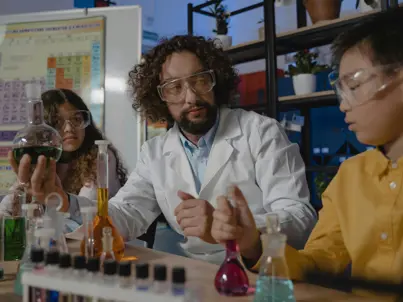
Below are 9 project ideas you can try, or to help inspire you!
#1: Which Liquid Helps Plants Grow Best?
Grow the same type of plant using different liquids, such as water, juice, soda, or a sports drink. Keep the plant type, soil, sunlight, and containers the same. Only change the liquid. You can use a timeframe of 2 to 4 weeks. This project explores plant biology and nutrition.
#2: Which Surface Has the Most Bacteria?
Using agar plates or standard classroom kits, test commonly touched surfaces, such as phone screens, desks, doorknobs, backpacks, and/or bathroom sinks. You can set the timeframe to 48 to 72 hours to see which surface shows the most bacterial growth. This project teaches about microbiology and hygiene. I suggest doing this only under adult supervision and following all safety rules for handling and disposing of samples.
#3: Does Music Affect Concentration?
Test whether background noise or music changes how quickly people complete a task, such as a word search, memory game, or math worksheet. Compare whether music helps or hinders different people. This project links science and psychology. There is no need to collect private information. Instead, use anonymous results and calculate simple group averages.
#4: Which Insulating Material Keeps Ice Frozen the Longest?
Wrap ice cubes in common household materials, such as foil, cotton, or newspaper. See which one delays melting the most. You can connect these results to the efficiency of lunch boxes or refrigerators. You can also consider this to be the insulating material that slows ice melting the most.
#5: How Does Temperature Affect Battery Life?
Test and compare the performance of batteries at different temperatures: room, cold, or warm. Use only safe household batteries. Power the same device and compare the run time. This project helps you learn about energy and applied technology.
#6: Which Paper Towel Is the Strongest?
Compare different brands or types of paper towels by testing how much weight each one can hold when wet. You can test this by seeing which towel holds the most amount of quarters before tearing when wet. This project shows why controlled testing matters. Each paper towel should be the same size and tested with the same amount of water and the same number of coins.
#7: Can Natural Materials Filter Water?
Make simple filters with sand, gravel, or cotton. Compare how clear the water becomes. Compare which filter material removes the most visible particles from dirty water. Don’t drink the filtered water! Only test how well it removes particles.
#8: How Does Exercise Affect Heart Rate?
Measure your heart rate before and after activities, such as walking or jogging. Compare which activity increases heart rate the most after a duration of one minute. The Centers for Disease Control and Prevention provides further information on physical activity and health for children and adolescents.
#9: Does the Shape of a Paper Airplane Affect Distance?
Fold paper airplanes with different wing shapes and measure how far each flies to see which travels the furthest. Test each design several times and average the distances for accuracy.
If you’re still stuck on finding the right topic, AI can help students brainstorm and organize ideas, but always do your own work. Compare several AI-generated ideas to see if each is safe, testable, and practical. For more information on emerging STEM tools, students can read Top AI & STEM Programs for Middle Schoolers in 2026. Remember: AI is a tool, not a shortcut. If you’re unclear about how to use AI responsibly, always follow your school’s rules about using AI.

Tips for a Successful Middle School Science Fair Project
1. Begin with a clear question: Completing your project becomes much easier when your question is specific and measurable
2. Make a hypothesis: This is an educated guess about what you think will happen.
3. Control your variables: Change only one thing at a time. This will help you see what caused the result.
4. Repeat your experiment: Testing more than once makes your results more reliable.
5. Record your data: Use charts, tables, photos, and notes to keep track of your findings.
6. Be honest when you explain your results: There’s no need for your project to prove your hypothesis right. Instead, your evidence should either support or not support your hypothesis.
7. Practice your presentation: Prepare to explain what you tested, what happened, and most importantly, what you learned.
For additional guidance on science fair experiments, NASA’s Jet Propulsion Laboratory offers STEM activities, including the Engineering Design Process, that connect science ideas to the real-world.
What To Include on a Science Fair Board
When your project is ready, it’s time to think about what to include on your science fair board. A good science fair board should be organized and easy to read. Most boards typically include the following:
● Title
● Question
● Hypothesis
● Background research
● Materials
● Procedure
● Variables
● Data and graphs
● Results
● Conclusion
● Photos or diagrams
● Future questions
Keep in mind not to overcrowd your board; aim for clarity! Your goal is to make your project clear to judges, teachers, classmates, family, and friends.
For more guidance, Science Buddies provides science fair resources and project instructions for students.

Final Thoughts
Choosing What to Do for Science Fair in Middle School becomes easier once you start using your curiosity and turning it into a question you can test. Whether you’re interested in plants, bacteria, exercise, paper airplanes, insulation, or AI, science fair projects are meant to help you practice real-world scientific thinking.
Growing up, I wanted to explore my interest in STEM. I found science workshops and after-school clubs run by professional women in these fields. Their support inspired me toward a career in this field. To learn more about experiments and projects that encourage girls in STEM, please visit Science for Girls, By Girls.
A successful science fair project isn’t about picking the coolest or hardest topic. It’s about asking a thoughtful question, testing it carefully, learning from your results, and explaining what you did clearly.
With intentional planning and creativity, science fairs can help you build confidence, strengthen your STEM skills, and find new interests that could last into high school, college, and beyond.